
Sub-Total: $0.00
American Made Christmas Yard Decorations: 2026 Guide
| Blog
Table of Contents
- Why American Made Christmas Yard Decorations Stand Apart
- Durable Outdoor Holiday Light Sculptures Built to Last
- How to Verify Authentic American-Made Holiday Decor
- Weather-Resistant Outdoor Christmas Decor for Harsh Climates
- Commercial Grade Christmas Displays for Serious Enthusiasts
- Maintenance and Storage: Making Your Investment Last
- DIY Setup vs. Professional Installation: What to Expect
- Frequently Asked Questions
Last Updated: September 23, 2026
Why American Made Christmas Yard Decorations Stand Apart
Walk through any big-box store in November and you will find the same thin wire frames and brittle plastic, boxed and ready for a single season. This guide from The Holiday Light Store explains why American made christmas yard decorations are built differently, and why the difference shows up the moment the weather turns. Domestic makers tend to start with heavier gauge steel, then finish each piece by hand rather than stamping it out by the thousand.
Materials That Survive Winter
Winter is the real test. Powder-coated steel resists rust far better than painted wire, and UV-protected finishes keep vivid colors from fading after one season in direct sun. Many homeowners find that the frame, not the lights, is what fails first on cheap imports. Heavy-duty, weather-resistant construction is the single biggest factor in how long a display lasts.
The Real Cost of Replacing Cheap Decor Annually
A display that costs less up front but gets replaced every year rarely saves money. A common mistake is buying on price alone, then discovering the frame has bent or the coating has flaked by January. Durable decor is an investment that pays back across many seasons instead of one.
Watch Out
Thin wire frames bend under snow load and cannot be straightened reliably. Once the coating cracks, moisture reaches the steel and rust spreads from the inside, which is why bargain displays rarely survive a second winter.
Thin wire frames bend under snow load and cannot be straightened reliably. Once the coating cracks, moisture reaches the steel and rust spreads from the inside, which is why bargain displays rarely survive a second winter.
Durable Outdoor Holiday Light Sculptures Built to Last
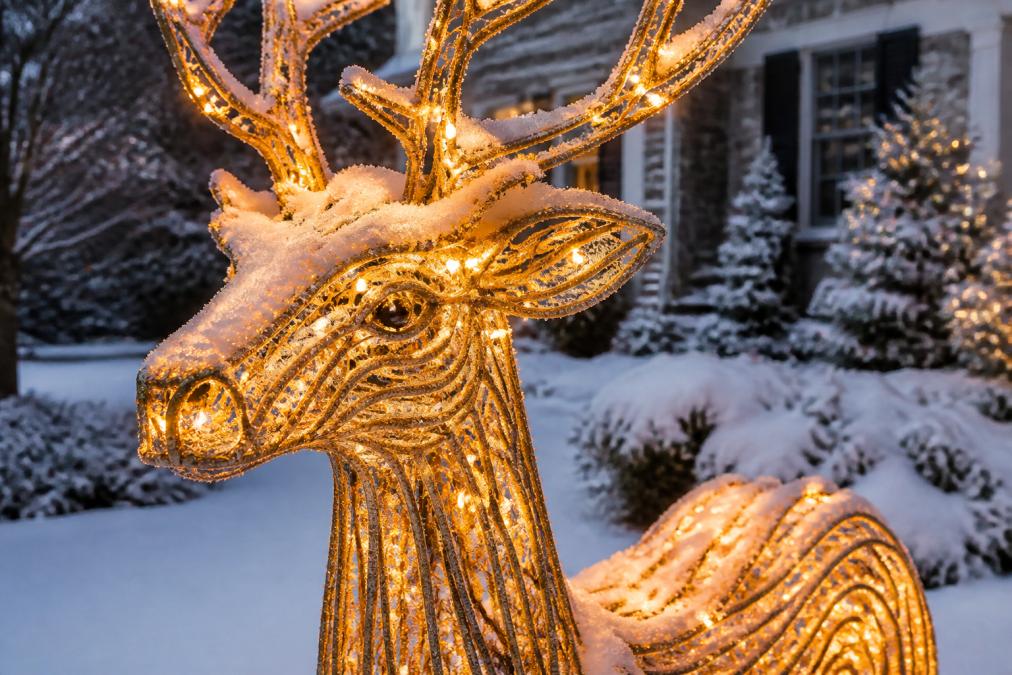
Durable outdoor holiday light sculptures combine a welded metal frame, a protective coating, and commercial-grade LED strands. That combination is what separates a piece that lasts a decade from one that lasts a season. Handcrafted construction means each frame is checked and finished individually, not pulled off a high-speed line.
Look for these signs of quality:
- Welded, not clipped, frame joints
- Uniform powder coating with no thin spots
- Sealed LED connections rated for outdoor use
- Replaceable bulbs or strands rather than sealed units
How to Verify Authentic American-Made Holiday Decor
Verifying a “made in USA” claim takes about two minutes, and it is worth every second. The Federal Trade Commission’s Made in USA guidance sets clear standards for when a product may carry an unqualified domestic claim. A genuine claim means all or virtually all of the product’s significant parts and processing are domestic.
Reading Labels and Certifications
Vague phrases like “designed in America” or “assembled domestically” are not the same as “made in the USA.” Ask for the specific wording and where the core components originate. Reputable makers will answer without hesitation.
Questions to Ask Before You Buy
- Where is the frame welded and the coating applied?
- Are replacement parts available if a strand fails?
- What does the warranty actually cover, and for how long?
Pro Tip
Ask the seller to name the specific facility where the frame is built. A maker who manufactures domestically can answer in one sentence. A reseller of imported goods usually cannot.
Ask the seller to name the specific facility where the frame is built. A maker who manufactures domestically can answer in one sentence. A reseller of imported goods usually cannot.
Weather-Resistant Outdoor Christmas Decor for Harsh Climates
Weather-resistant outdoor Christmas decor is engineered for the conditions it will actually face, not a mild display window. Coastal wind, lake-effect snow, freeze-thaw cycles, and high-altitude UV each stress a display differently, and the right spec for one climate can be the wrong spec for another. The National Weather Service winter safety resources note that wind and ice loads are what most often damage structures left outdoors, which is why the frame and anchoring matter more than the lights.
How Each Climate Attacks Your Decor
- Coastal salt air. Salt accelerates corrosion on bare metal and on any coating with pinholes or scratches. Powder coating helps, but the cut ends of wire and any exposed fastener are the first to rust. Rinsing frames with fresh water before storage removes salt residue.
- Lake-effect and heavy snow. Wet snow is dense and heavy. It loads the top of a frame and can bend thin wire permanently. Frames with cross-bracing and wider bases shed load better than tall, narrow silhouettes.
- Freeze-thaw cycles. Water enters small cracks in a coating, freezes, expands, and widens the crack. Over a season this is what turns a pinhole into a rust streak. A flexible, UV-protected powder coat tolerates this movement far better than a brittle paint.
- High wind. Wind does not just push a display over; it fatigues the frame at joints. Welded joints and guy lines anchored to the frame, not the light strand, are what keep a piece upright.
- High-altitude sun. UV intensity rises with elevation, and unprotected plastic and paint fade or chalk within a single season. UV-stabilized coatings and LED housings are the fix.
Matching the Spec to Your Yard
For exposed or windy yards, prioritize:
- Heavier frames with cross-bracing that resist tipping and fatigue
- Ground stakes and guy lines rated for the load, anchored to the frame
- UV-protected powder coatings for sunny, high-altitude sites
- IP-rated connectors if the display will see direct rain or snowmelt
For sheltered yards or mild climates, a lighter frame is often fine, and the money is better spent on replaceable LED strands and a good timer.
Installation for Harsh Weather
A few installation habits make a large difference in how a display survives the season:
- Anchor to the frame, not the light strand. Strands stretch and break under load.
- Use guy lines on any piece taller than about 4 feet in an open yard.
- Keep connections off the ground. Snowmelt and standing water are the most common cause of mid-season failures.
- Leave a small drip loop in every cord so water runs off rather than into the connector.
- Check stakes after the first hard freeze; frost heave loosens them.
Watch Out
A display that survives one mild winter is not proof of weather resistance. The failure modes above often take two or three seasons to show, which is why frame gauge and coating quality matter more than a single season of performance.
A display that survives one mild winter is not proof of weather resistance. The failure modes above often take two or three seasons to show, which is why frame gauge and coating quality matter more than a single season of performance.
A Maintenance Habit That Pays Off
Inspect frames after every major storm. Look for cracked coating, bent bracing, and loose stakes. Touching up bare metal with a matching paint before storage stops rust from spreading under the coating, which is the most common way a good frame is lost.
Commercial Grade Christmas Displays for Serious Enthusiasts
Commercial grade Christmas displays are built to run night after night for an entire season without failure, and the differences from residential decor show up in the frame, the wiring, and the power system. For enthusiasts who host tours, charity walks, or synchronized shows, those differences are the line between a display that runs reliably and one that flickers out mid-December.
What Actually Makes a Display Commercial-Grade
Commercial-grade pieces share a handful of engineering traits that residential decor rarely has:
- Frame gauge and bracing. Frames use heavier steel with cross-bracing at stress points, so a 6-foot reindeer does not sag in the middle after a season of wind. Residential frames often use thinner wire with no bracing.
- Welded joints, not clips. Clips loosen with thermal cycling; welds do not. This is the single most common failure point on budget decor.
- Replaceable LED strands. Commercial pieces use standard string harnesses you can swap in minutes. Sealed residential units must be discarded when a single section fails.
- Higher-capacity LED drivers. Commercial drivers tolerate voltage drop across long runs and cold-weather startup, which is where cheap drivers fail first.
- IP-rated connectors. Look for connectors rated for direct water exposure, not just “outdoor use.” The rating tells you how much rain and snowmelt the connection can take.
Power Planning for a Large Display
Most residential circuits are 15 amps at 120 volts, which is roughly 1,800 watts. The National Electrical Code’s 80-percent rule means you should plan to draw no more than about 1,440 watts on a single circuit. A common pattern is to split a large display across two or three dedicated circuits rather than daisy-chaining everything into one outdoor outlet.
- Add up the rated wattage of every strand and driver before you buy.
- Keep each circuit under 80 percent of its breaker rating.
- Use outdoor-rated cords with the correct gauge for the run length; voltage drop over a long cord causes flicker and premature LED failure.
- Put the whole display on a timer or smart plug so it is not running unattended overnight.
Installation and Teardown Realities
Commercial-grade decor is heavier, which is both the point and the trade-off. A large piece may need two people to position, and ground stakes alone are often not enough in open yards. Most installers use a combination of stakes, guy lines, and weighted bases, and they anchor to the frame rather than the light strand.
| Feature | Standard Decor | Commercial-Grade Decor |
|---|---|---|
| Frame gauge | Thin wire, no bracing | Heavy steel with cross-bracing |
| Joints | Clips or crimps | Welded |
| Coating | Basic paint | Powder-coated, UV-protected |
| LED quality | Sealed strands | Replaceable commercial strands |
| Connectors | “Outdoor use” | IP-rated for direct water exposure |
| Power | Single circuit, often overloaded | Planned across dedicated circuits |
| Expected lifespan | 1-2 seasons | Many seasons |
| Best for | Mild climates, small yards | Harsh weather, high-traffic displays |
Pro Tip
Before buying a large piece, ask the maker for the rated wattage and the recommended circuit size. A commercial-grade manufacturer will have both numbers ready. A reseller of imported decor usually will not.
Before buying a large piece, ask the maker for the rated wattage and the recommended circuit size. A commercial-grade manufacturer will have both numbers ready. A reseller of imported decor usually will not.
A Note on Sourcing
Commercial-grade does not automatically mean domestic. Plenty of imported decor is marketed as “commercial grade” without the frame gauge, driver specs, or connector ratings to back it up. If domestic manufacturing matters to you, apply the same verification steps you would use for any other piece: ask where the frame is welded, where the coating is applied, and whether replacement parts are stocked domestically.
Maintenance and Storage: Making Your Investment Last
Maintenance is where most owners lose years of life from good decor. A simple routine each January protects the investment far better than any repair. The U.S. Department of Energy guidance on LED lighting confirms that LED strands last far longer than incandescent, but only when connections stay dry and undamaged.
- Inspect for cracked coating and touch up bare metal
- Coil strands loosely; never kink the wire
- Store frames off the floor in a dry, rodent-free space
- Label each piece so setup is faster next season
Key Takeaway
Ten minutes of careful storage in January routinely adds several seasons to a quality display. Neglect is the most common reason good decor fails early.
Ten minutes of careful storage in January routinely adds several seasons to a quality display. Neglect is the most common reason good decor fails early.
DIY Setup vs. Professional Installation: What to Expect
Most homeowners can set up a quality display themselves in an afternoon. The key is planning power before you place a single piece. Add up the wattage of every strand, keep each circuit within its limit, and use outdoor-rated cords and timers. This is where cheap decor often fails: it draws more power and trips breakers.
Frequently Asked Questions
Are any Christmas lights made in the USA?
Yes, some Christmas lights and yard decorations are made domestically. Look for products labeled ‘Made in USA’ with a qualification like ‘Made in USA with domestic and imported parts.’ Handcrafted light sculptures from small American workshops often use domestic steel and powder-coating. Always check the packaging or ask the seller directly for verification.
What materials are best for long-lasting outdoor Christmas yard displays?
Powder-coated steel, fiberglass, and UV-protected plastics hold up best against snow, rain, and wind. Powder coating prevents rust on metal frames, while fiberglass resists cracking in freezing temperatures. LED lighting uses less energy and lasts far longer than incandescent bulbs. These materials cost more upfront but often outlast cheaper alternatives by several seasons.
How can I identify authentic American-made outdoor Christmas decor?
Check for a ‘Made in USA’ label with a qualification statement, such as ‘Made in USA with domestic and imported parts.’ The Federal Trade Commission requires accurate origin claims. Ask the seller where the product is manufactured and assembled. Small workshops often share photos of their production process, which is a good sign of transparency.
Are there commercial-grade Christmas decorations manufactured domestically?
Yes, several American workshops produce commercial-grade Christmas displays for municipalities, shopping centers, and large residential displays. These products typically use heavy-duty steel frames, powder coating, and commercial LED lighting rated for continuous outdoor use. They cost more than retail-grade options but are built to withstand years of seasonal installation and removal.
The real challenge with holiday decor is not finding something festive. It is finding something that still looks vivid and intact after several winters. The Holiday Light Store builds animated light sculptures by hand, powder-coats each frame for weather resistance, and stands behind decor made to last season after season. Explore the collection and create a display your family will look forward to every year.
