
Sub-Total: $0.00
Best Weather-Resistant Holiday Decorations: 2026 Guide
| Blog
Table of Contents
- What Makes Holiday Decorations Weather-Resistant
- Powder-Coated Metal Holiday Decor: Why It Outperforms Other Materials
- UV-Protected and Rust-Resistant Materials That Last
- Securing Outdoor Holiday Displays from Wind: Installation Best Practices
- Weatherproof Extension Cords for Holiday Lights: Safety and Setup
- Maintenance and Storage to Extend Decoration Lifespan
- Frequently Asked Questions
Last Updated: September 25, 2026
What Makes Holiday Decorations Weather-Resistant
Weather-resistant holiday decorations are designed to withstand exposure to rain, snow, wind, UV rays, and temperature fluctuations without deteriorating. The key to durability lies in material selection, protective coatings, and construction methods that prevent rust, fading, cracking, and moisture damage.
The difference between a decoration that lasts one season and one that lasts a decade comes down to three factors: the base material, the protective finish, and how well it’s sealed against the elements. Most outdoor holiday displays fail because they’re built with materials that absorb moisture or corrode when exposed to salt air, freeze-thaw cycles, or intense sunlight.
At The Holiday Light Store, we focus on materials that have proven track records in harsh climates. Powder-coated metal, UV-protected synthetic materials, galvanized steel, and resin compounds are the standards we use because they actually perform. A decoration that looks great in a showroom but falls apart after one winter isn’t a bargain, it’s a waste of money.
The materials matter more than the design. An ornament made from cheap plastic will fade and crack regardless of how beautiful it looks initially. A powder-coated metal sculpture, by contrast, can look nearly identical after five years of outdoor exposure.
Key Takeaway
The most durable outdoor holiday decorations combine weather-resistant base materials with protective coatings that create a barrier against moisture, UV rays, and salt air exposure.
The most durable outdoor holiday decorations combine weather-resistant base materials with protective coatings that create a barrier against moisture, UV rays, and salt air exposure.
Powder-Coated Metal Holiday Decor: Why It Outperforms Other Materials
Powder-coated metal is the gold standard for outdoor holiday displays that need to last. This finish involves applying a dry powder to metal surfaces, then baking it at high temperatures to create a hard, protective shell that bonds permanently to the metal underneath.
The advantage over traditional paint is significant. Paint sits on top of metal and can chip, peel, or crack. Powder coating becomes part of the surface itself, creating a unified protective layer that resists impact, UV fading, and moisture penetration. Powder-coated metal decorations can last for years with minimal maintenance.
Why does this matter for your holiday display? Because rust is the enemy of outdoor metal. Standard painted metal eventually shows rust spots where the paint has worn away. Powder coating resists this degradation far longer. The coating fills microscopic imperfections in the metal surface, creating a seal that keeps moisture out.
The trade-off is cost. Powder-coated metal decorations cost more upfront than plastic or painted alternatives. But when you consider their durability, the long-term value becomes clear.
UV-Protected and Rust-Resistant Materials That Last
Beyond powder-coated metal, several other materials deliver genuine weather-resistant performance when properly manufactured. Understanding what makes them durable helps you identify quality pieces.
Resin and Polyresin are synthetic materials engineered to resist UV fading, moisture absorption, and temperature extremes. High-quality resin decorations won’t crack in freeze-thaw cycles the way cheap plastic does. The material remains flexible enough to expand and contract without breaking. Resin is heavier than plastic, which makes it more stable in wind, and it holds paint and finishes far better than hollow plastic.
Synthetic Garland and Greenery made from UV-protected polyethylene or PVC won’t fade to gray or brown after a single season outdoors. Standard plastic garland becomes brittle and discolored within months. UV-protected versions use additives that block ultraviolet radiation, preserving color and flexibility. These materials also resist moisture absorption, so they don’t become waterlogged or develop mold.
Galvanized and Stainless Steel provide the foundation for rust-resistant metal ornaments. Galvanizing is a process that coats steel with a layer of zinc, creating a barrier against oxidation. Stainless steel contains chromium, which forms a protective oxide layer naturally. Both resist corrosion far better than bare steel, especially when combined with powder coating.
PVC and Vinyl Materials for inflatable displays are engineered to resist cracking and UV degradation. Quality inflatables use reinforced PVC with UV inhibitors that prevent the material from becoming brittle. Cheaper inflatables crack at the seams and develop stress fractures during freeze-thaw cycles.
The pattern is clear: materials designed specifically for outdoor durability cost more than generic alternatives, but they perform dramatically better over time.
Securing Outdoor Holiday Displays from Wind: Installation Best Practices
Wind is the silent killer of outdoor holiday displays. A beautiful decoration that isn’t properly anchored becomes a projectile in a strong gust. Securing outdoor displays from wind requires understanding both the weight distribution of your decoration and the wind load your location experiences.
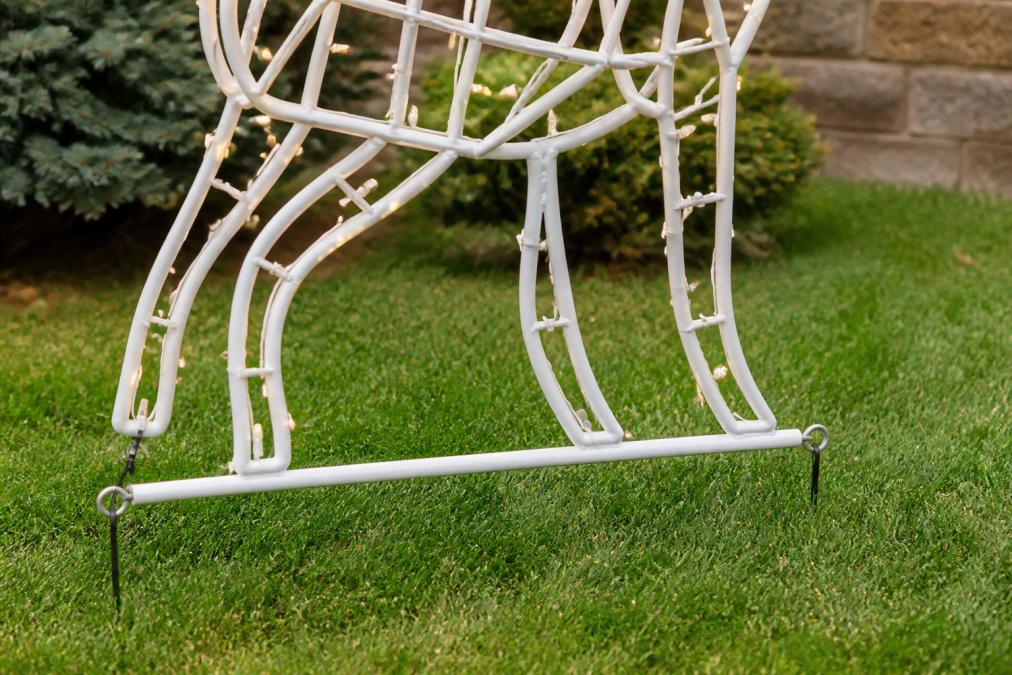
The foundation of wind resistance is proper anchoring. Ground stakes, guy wires, and weighted bases work together to keep displays stable. For metal sculptures and large inflatables, ground stakes should be driven at least 12-18 inches into the ground at 45-degree angles. Guy wires attached to the top of the decoration and anchored to stakes on multiple sides distribute wind force across the installation, preventing tipping.
Most homeowners underestimate how much wind their displays need to withstand.
The weight of your decoration matters significantly. Heavier pieces are more stable in wind, but they require more strong anchoring. Lightweight inflatables need substantial guy wire systems. Solid metal sculptures can often rely on ground stakes alone if the base is wide enough.
Installation timing also affects stability. Never install displays during windy conditions. Install them on calm days and double-check all anchors after the first significant wind event. Many failures happen because anchors loosen slightly over time. A seasonal inspection ensures everything remains tight.
Watch Out
Undersized or improperly installed guy wires are a common cause of display failure.
Undersized or improperly installed guy wires are a common cause of display failure.
Weatherproof Extension Cords for Holiday Lights: Safety and Setup
Electrical safety is non-negotiable with outdoor holiday lighting. A weatherproof extension cord designed for outdoor use is fundamentally different from an indoor cord, and using the wrong cord creates fire and shock hazards.
Outdoor-rated extension cords have thicker insulation, more durable jackets, and connectors designed to shed water rather than trap it. The cord’s gauge (thickness) matters too. A thin cord running a high-powered light display will overheat and potentially cause a fire. The longer the cord run, the thicker it needs to be to prevent voltage drop and overheating.
Many homeowners connect too many displays to one cord and trigger breaker trips. The solution is understanding your electrical load.
Cord placement matters as much as the cord itself. Never run extension cords through water, under heavy foot traffic, or across sharp edges. Protect cords with conduit where they cross driveways or walkways. Coil excess cord loosely rather than wrapping it tightly around a stake, tight coils can damage the insulation.
Ground fault circuit interrupter (GFCI) protection is essential for all outdoor electrical connections. A GFCI outlet detects electrical faults and cuts power instantly, preventing electrocution. Most modern outdoor outlets have built-in GFCI protection. If yours doesn’t, use a GFCI adapter between the outlet and your extension cord.
Pro Tip
Test your GFCI protection monthly during the holiday season by pressing the test button. The outlet should cut power. Press reset to restore it. A GFCI that doesn’t respond needs replacement before you use it.
Test your GFCI protection monthly during the holiday season by pressing the test button. The outlet should cut power. Press reset to restore it. A GFCI that doesn’t respond needs replacement before you use it.
Maintenance and Storage to Extend Decoration Lifespan
How you care for weather-resistant decorations during the off-season determines how long they’ll last. Proper storage and basic maintenance can add years to the lifespan of even the most exposed displays.
Before storing anything, inspect it for damage. Small cracks in resin, loose connections, or areas where the powder coating is chipped should be addressed immediately. Resin cracks can be sealed with epoxy. Addressing minor damage prevents water infiltration that causes major problems over time.
Clean decorations before storage. Dirt, salt residue, and organic growth like mold or mildew accelerate deterioration. Use a soft brush and mild soap solution. Rinse thoroughly and allow everything to dry completely before storing. Moisture trapped during storage causes rust and mold growth.
Storage location matters significantly. A climate-controlled garage or shed is ideal. If you don’t have that option, use a storage container that sheds water and allows air circulation. Never store decorations directly on concrete or soil, where moisture wicks up into the material. Use wooden pallets or shelving to create air space underneath.
For inflatable displays, deflate them completely and fold them loosely rather than cramming them into tight spaces. Tight folding creates stress points that can crack or split the material. Store inflatables in a cool, dry location away from direct sunlight.
Check stored decorations periodically during the off-season. A quick visual inspection every few months catches problems before they become severe. If you notice moisture inside a storage container, improve ventilation or move the container to a drier location.
Building a holiday display that lasts requires choosing materials engineered for outdoor durability and installing them correctly.
| Material | Best For | Expected Lifespan | Maintenance Level |
|---|---|---|---|
| Powder-coated metal | Large sculptures, high-wind areas | 10-15 years | Low |
| resin | Ornaments, figurines, moderate climates | 8-12 years | Low |
| Synthetic garland | Greenery, wreaths, mixed displays | 5-8 years | Minimal |
| Galvanized steel | Metal yard ornaments, stakes | 10+ years | Low |
| Quality PVC inflatables | Large displays, coastal areas | 6-10 years | Moderate |
Frequently Asked Questions
What materials make outdoor holiday decorations weather-resistant?
The best weather-resistant holiday decorations use powder-coated metal and galvanized steel. Powder coating creates a protective barrier that prevents rust and fading. Galvanized metal resists corrosion even in coastal or humid climates. Avoid untreated wood and standard plastic, which deteriorate quickly outdoors.
How do I secure outdoor holiday decorations against high winds?
Anchor displays using ground stakes, guy wires, or weighted bases designed for your specific decoration type. For inflatable displays, use multiple anchor points rather than relying on a single stake. Guy wires should be taut and angled away from the display at 45 degrees. Test your setup before severe weather arrives.
Are powder-coated light sculptures better for outdoor use?
Yes. Powder coating creates a durable, weather-resistant finish that outperforms standard paint or bare metal. It resists rust, UV fading, moisture penetration, and salt spray damage, critical in harsh climates. Powder-coated decorations maintain their appearance through multiple seasons with minimal maintenance. The finish is thicker and more uniform than liquid paint, offering superior protection against the elements and extending the lifespan of metal yard ornaments significantly.
What’s the difference between weather-resistant and weatherproof holiday decorations?
Weather-resistant decorations withstand rain, snow, and temperature changes but may show wear over time with proper care. Weatherproof decorations are engineered to resist moisture intrusion completely, often with sealed electronics and fully enclosed components. Most premium outdoor holiday lighting uses weather-resistant materials with sealed electrical connections rather than fully weatherproof designs, offering durability without excessive cost.
