
Sub-Total: $0.00
Long Lasting Outdoor Christmas Display Ideas
| Blog
Table of Contents
- Long Lasting Outdoor Christmas Display Ideas That Survive Every Season
- Weather-Resistant Outdoor Christmas Decorations: What Actually Holds Up
- Outdoor Christmas Lighting Ideas Built for the Long Haul
- How to Hang Outdoor Christmas Lights So They Last All Winter
- DIY Outdoor Decorations: Wreaths, Garlands, and Evergreen Accents That Hold Their Shape
- Outdoor Christmas Decoration Storage That Protects Your Investment
- Electrical Safety and Power Planning for a Bigger Display
- Conclusion: Build It Once, Enjoy It for Years
- Frequently Asked Questions
Last Updated: October 16, 2026
Long Lasting Outdoor Christmas Display Ideas That Survive Every Season
Most outdoor Christmas decorations are built for one season, not ten.
The answer comes down to three things: what the product is made of, how it is rated for weather, and how you install and store it.
Below, we break down the materials that hold up, the ratings that matter, the layouts that stay lit, and the storage habits that protect your investment.
Key Takeaway
Durability is a system, not a sticker. Material, IP rating, installation method, and storage all have to work together, or the weakest link sets your display’s lifespan.
Durability is a system, not a sticker. Material, IP rating, installation method, and storage all have to work together, or the weakest link sets your display’s lifespan.
Weather-Resistant Outdoor Christmas Decorations: What Actually Holds Up
Weather-resistant outdoor Christmas decorations are engineered to survive moisture, freeze-thaw cycles, wind, and UV without corroding, cracking, or losing their finish.
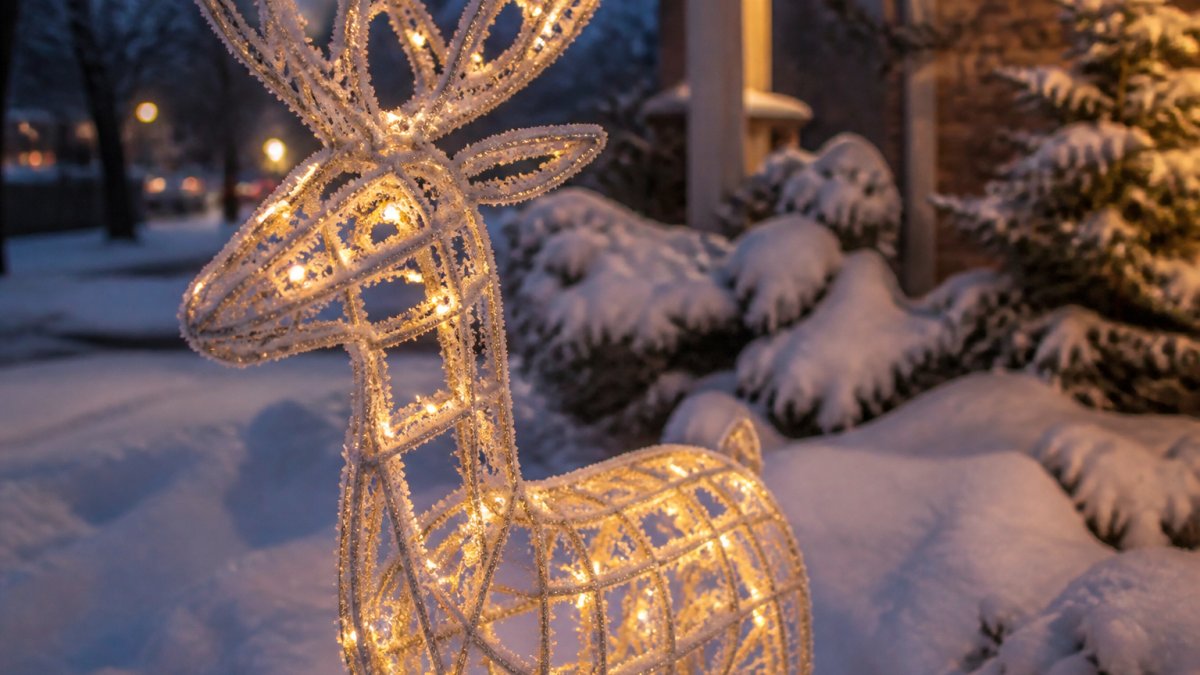
Materials That Last: Powder-Coated Metal, Commercial-Grade LED, and Treated Evergreen
Powder coating is the biggest durability upgrade most homeowners overlook.
Commercial-grade LED is the second piece. Residential strands use thin wire and unsealed bulb bases; commercial-grade LED uses heavier gauge wire and sealed connections, which keeps a strand lit through rain, sleet, and freeze-thaw cycles.
For natural materials, treated evergreen and preserved greenery hold color and shape longer than fresh cuttings, the difference between a wreath that looks full in January and one that only looked good in December.
IP Ratings and Outdoor-Rated Labels Explained
IP rating is a two-digit standard for dust and water resistance. The first digit covers solids, the second covers liquids, and for outdoor holiday decor, the second digit matters most.
| IP Rating | Water Protection | Best For |
|---|---|---|
| IP44 | Splash-resistant | Covered porches, sheltered entries |
| IP65 | Water jets, dust-tight | Exposed rooflines, walkway lights |
| IP67 | Temporary immersion | Low-lying yard decor, snow contact |
| IP68 | Continuous immersion | Ponds, fountains, permanent fixtures |
If a product does not list an IP rating, treat it as indoor-only. “Outdoor-rated” without a number is marketing language, not a specification.
Watch Out
Skipping the IP rating is the most common mistake we see. A strand rated IP44 on an exposed roofline will take on water in the first heavy storm, and the corrosion starts inside the wire where you cannot see it until the strand dies.
Skipping the IP rating is the most common mistake we see. A strand rated IP44 on an exposed roofline will take on water in the first heavy storm, and the corrosion starts inside the wire where you cannot see it until the strand dies.
Outdoor Christmas Lighting Ideas Built for the Long Haul
Outdoor Christmas lighting ideas that last are planned around zones, not a single strand. Break the yard into four zones, roofline, windows, trees, and ground level, and choose products rated for each zone’s exposure.
Roofline, Window, and Tree Lighting That Stays Lit
Roofline lights take the worst weather: wind, ice, direct rain, and full sun. Use commercial-grade LED with sealed connections and clip them to the fascia rather than stapling through the wire, staples pierce insulation, and that pinhole is where corrosion begins.
Window lights sit in a middle zone, often sheltered by an overhang, so IP44 or IP65 works fine. The failure point is usually the suction cup or adhesive, not the light.
Tree lights should be wrapped, not draped. A wrap holds the strand against the trunk and branches, reducing wind movement and keeping the wire from whipping against itself.
Walkway, Entryway, and Yard Display Concepts
Walkway and entryway displays take foot traffic, snow shovels, and salt. Keep cords off the ground and use path stakes rather than laying strands on pavement. Low-lying yard pieces should be IP67 or better, since snowmelt pools around the base.
A few concepts that hold up well across seasons:
- Pre-lit topiaries flanking the front door, weighted at the base
- Lighted wreaths on windows with a dedicated hook, not adhesive
- Net lights over shrubs, which distribute weight evenly and resist wind
How to Hang Outdoor Christmas Lights So They Last All Winter
Hanging lights so they survive the season is a four-step process: test, plan the power, secure the run, and seal the connections. Skipping any step shortens the display’s life.
- Test every strand before it goes up. Plug in each strand indoors and check for dead sections, a bad strand on a roofline means climbing up to remove it in the cold.
- Map your power before you climb. Decide which outlets feed which zones and add up the load. Overloading a household circuit is the fastest way to a mid-December outage.
- Secure with clips, not staples or nails. Clips hold the wire without piercing insulation; nails and staples create entry points for water.
- Seal exposed connections. Wrap plug connections with electrical tape or use a connection cover, especially at ground level where snowmelt collects.
- Leave a drip loop. Where a cord runs down to an outlet, let it hang slightly below the outlet so water runs off instead of into the socket.
Pro Tip
Photograph your layout before you take it down. A few phone photos of which strand feeds which zone will save you an hour of guesswork next November, and they make storage labeling almost automatic.
Photograph your layout before you take it down. A few phone photos of which strand feeds which zone will save you an hour of guesswork next November, and they make storage labeling almost automatic.
DIY Outdoor Decorations: Wreaths, Garlands, and Evergreen Accents That Hold Their Shape
DIY outdoor decorations last longer when the frame is sturdy and the materials are treated.
For a wreath that survives the season, start with a powder-coated or heavy-gauge wire frame, then build on treated evergreen or preserved greenery.
Garlands follow the same logic: a treated evergreen garland on a wire spine holds its shape, while foam or plastic can crack in freezing temperatures.
The DIY pieces that last are built to be repaired, not replaced.
Outdoor Christmas Decoration Storage That Protects Your Investment
Storage is where a display’s lifespan is decided. A powder-coated sculpture and a commercial-grade LED strand can both fail in the off-season if they sit in a damp garage or crushed box for nine months. The goal is not tidiness, it is controlling moisture, UV, heat, and mechanical stress while the display is dormant.
The failure modes are predictable:
- Corrosion creep. Moisture that reaches a connection keeps working on the copper even while unplugged, bridging the contact before you plug it in next season.
- Insulation cracking. Wire insulation and plastic housings get brittle with freeze-thaw cycles and UV. A bin in an unheated shed that swings between 20°F and 50°F ages faster than one in a stable, dry space.
- Frame deformation. Wet greenery is heavy. A wreath or garland stored flat under other bins bends its wire spine, and a bent spine never hangs the same way again.
Material-Specific Storage Rules
Different materials fail for different reasons, so one bin strategy does not work for a whole display.
| Material | Primary Risk | Storage Approach |
|---|---|---|
| Commercial-grade LED strands | Moisture in connections, tangling stress | Wind on a reel or spool, store in a sealed bin with a desiccant packet |
| Powder-coated metal sculptures | Chipped coating, ground moisture | Wrap in breathable cloth, store off the floor on a shelf or pallet |
| Treated or preserved evergreen | Crushing, trapped moisture | Hang or lay flat in a breathable container, never a sealed plastic bag |
| Cords and extension cables | Kinks, cracked insulation, rodent damage | Coil loosely at a diameter of at least 12 inches, tie with hook-and-loop, store separately |
| Adhesive clips and suction cups | Loss of tack, dust contamination | Store in a sealed bag; replace rather than reuse if the adhesive is compromised |
A few habits that make the difference:
- Store lights on reels or spools, not tangled in bags. Tangled strands get yanked apart in November, and that stress breaks the internal wire.
- Keep greenery in breathable containers. Sealed plastic traps moisture against the needles and accelerates mold and browning.
- Store metal sculptures off the floor, on shelves or pallets, to avoid ground moisture wicking into the base.
A Between-Season Maintenance Routine
The storage window is also the maintenance window. A 30-minute routine in January saves hours of troubleshooting in November.
- Inspect before you store. Look for cracked insulation, corroded contacts, and chipped coating. A small touch-up on a powder-coated frame now prevents rust from spreading later.
- Test every strand. Plug in each strand and tag the failed ones so you know what needs repair rather than discovering it on a ladder in December.
- Clean and dry. Wipe down metal frames and let everything air-dry completely before binning. Storing anything damp is the most common cause of off-season corrosion.
- Label by zone. Match each bin to the zone it serves, roofline, windows, trees, ground, so next season’s setup is matching labels to your photos, not untangling a mystery.
- Repair now, not later. Reattach loose pinecones with floral wire, rewire sagging garland, and replace adhesive clips that lost their tack. Repairs in a warm garage are faster and cheaper than in freezing weather.
The Multi-Season Math
The reason storage and maintenance matter is economic. A commercial-grade LED strand that costs more upfront but lasts eight seasons has a lower cost per season than a budget strand replaced yearly. The same logic applies to powder-coated versus painted sculptures and treated evergreen versus fresh cuttings. Storage converts a higher upfront cost into a lower cost per season.
Key Takeaway
Treat storage as part of the display, not an afterthought. Moisture control, breathable containers, off-floor storage, and a January maintenance pass are what let a well-built display earn back its cost over multiple seasons.
Treat storage as part of the display, not an afterthought. Moisture control, breathable containers, off-floor storage, and a January maintenance pass are what let a well-built display earn back its cost over multiple seasons.
Electrical Safety and Power Planning for a Bigger Display
Electrical safety limits how large a display can get, and it is the constraint most homeowners underestimate. It is also a longevity issue: an overloaded circuit, corroded connection, or indoor-rated cord used outdoors shortens the life of every strand on that run, not just the one that fails first.
Outdoor Ratings and Ingress Protection
Outdoor electrical products carry ratings that tell you what they are built to survive. The two that matter most for holiday displays are the cord’s outdoor listing and the connector’s ingress protection (IP) rating.
- Outdoor-rated cords and power strips. Look for a listing mark from a recognized testing laboratory and language indicating outdoor use. Indoor extension cords have thinner insulation and no weather resistance; using one outdoors commonly causes tripped breakers and, worse, shock or fire hazards.
- IP ratings on connectors and fixtures. The second digit covers water. IP44 is splash-resistant for covered porches; IP65 handles water jets and dust for exposed rooflines and walkway lights; IP67 tolerates temporary immersion for low-lying yard decor in snowmelt. IP68 is for continuous immersion and is generally unnecessary for seasonal displays.
- GFCI protection. Ground-fault circuit interrupter protection is required for outdoor receptacles in most residential settings and is the single most important safety feature for a wet-environment display. A GFCI trips on a ground fault, the kind that occurs when water reaches a live connection, and can be a portable inline device or a breaker at the panel.
Watch Out
“Outdoor-rated” without a number is marketing language, not a specification. If a product does not list an IP rating or an outdoor listing, treat it as indoor-only, regardless of what the packaging implies.
“Outdoor-rated” without a number is marketing language, not a specification. If a product does not list an IP rating or an outdoor listing, treat it as indoor-only, regardless of what the packaging implies.
Load Planning: The Math Behind a Stable Display
A display that trips a breaker is not just inconvenient, repeated trips stress the circuit and the strands. The fix is load planning before you climb.
- Find the circuit’s capacity. A typical household branch circuit is rated for 15 or 20 amps at 120 volts, the ceiling for everything on that circuit, not just the display.
- Add up the load. Strand packaging lists wattage or amperage per strand. Add the strands on a circuit and compare the total to the circuit’s rating, leaving headroom for other loads.
- Do not exceed the manufacturer’s daisy-chain limit. Every strand has a maximum number that can be connected end-to-end, because the wire and connectors are sized for a specific current. Exceeding it commonly melts connectors.
- Distribute across circuits. If one circuit is near its limit, move a zone to a different circuit rather than upsizing the breaker. Breakers protect the wire in the wall; upsizing one to fit a display is a fire risk.
- Use timers rated for the load. An undersized timer fails early and can overheat. Match its rating to the total wattage it controls.
Connections, Drip Loops, and Water Management
Most electrical failures in a holiday display happen at connections, not mid-strand. Water reaches a plug, corrosion starts inside the contact, and the strand dies weeks later.
- Keep connections off the ground. Elevate plugs on stakes or clips so snowmelt and rain do not pool around them.
- Seal exposed connections. A connection cover or electrical tape at ground level reduces water ingress and extends strand life.
- Leave a drip loop. Where a cord runs down to an outlet, let it hang slightly below the outlet so water runs off the loop instead of into the socket.
When to Call a Licensed Electrician
If a breaker trips repeatedly after load redistribution, if you smell burning at an outlet or connector, if a cord or plug is warm to the touch, or if you are unsure your setup is safe, stop and have a licensed electrician review it. That is a small cost compared to a fire risk.
Key Takeaway
Electrical choices are longevity choices. Outdoor-rated cords, correct IP ratings, GFCI protection, load planning within the circuit’s capacity, and sealed, elevated connections are what keep a display lit through the season and reusable for the next one.
Electrical choices are longevity choices. Outdoor-rated cords, correct IP ratings, GFCI protection, load planning within the circuit’s capacity, and sealed, elevated connections are what keep a display lit through the season and reusable for the next one.
Conclusion: Build It Once, Enjoy It for Years
A big holiday display only feels worth it if it survives the season, and most decor does not. That is why we build our pieces the way we do: handmade, powder-coated, and made in the USA, with animated light sculptures designed to hold up year after year. If you want a display that dazzles for years instead of one that needs replacing every December, browse our collection and find the piece that fits your yard.
Frequently Asked Questions
How can I make an outdoor Christmas display last for years?
Start with materials built for repeated winters: powder-coated metal frames, commercial-grade LED bulbs, and UV-treated evergreen. Choose products with an IP65 or higher rating for wet locations. Install with clips and stakes instead of nails or staples that crack insulation. After the season, clean each piece, let it dry fully, and store it in labeled bins away from moisture and direct sun. A display assembled this way can run for many seasons without replacement.
Which outdoor Christmas decorations hold up best in bad weather?
Powder-coated metal sculptures, commercial-grade LED string lights, and treated evergreen hold up best. Powder coating resists rust and chipping far better than painted finishes. LED bulbs run cooler and draw less power than incandescent, so they handle temperature swings without filament failure. For coastal or high-wind areas, look for weighted bases and stainless steel hardware, since salt air corrodes cheaper metals quickly.
How do I protect outdoor Christmas decorations from rain, snow, and wind?
Use outdoor-rated products with a minimum IP65 rating for anything exposed to rain or snow. Anchor lightweight pieces with ground stakes or sandbags, and secure roofline lights with adhesive clips rated for cold temperatures. Elevate extension cord connections off the ground and wrap them with waterproof covers. In high-wind zones, take down fabric bows and ribbon during storms, since these catch wind and can pull down an entire section.
Are LED Christmas lights more durable for outdoor displays?
Yes. LEDs have no filament to burn out, so they tolerate vibration, cold, and moisture far better than incandescent bulbs. They also use roughly 75% less energy, which means you can run more of them on a single circuit without tripping breakers. Look for commercial-grade LEDs with sealed epoxy lenses rather than replaceable glass bulbs, since sealed units keep water out of the socket entirely.
What materials are best for long-lasting outdoor Christmas decorations?
Powder-coated steel and aluminum frames, commercial-grade LED lighting, UV-stabilized plastic, and treated natural evergreen are the top performers. Powder coating bonds to metal at high heat and resists chipping, fading, and rust. Aluminum resists corrosion better than steel in coastal areas. For natural elements, fresh evergreen lasts a season, but preserved or faux evergreen treated with UV inhibitors can be reused for several years if stored properly.
How should I store outdoor Christmas decorations to extend their life?
Clean and dry every piece before storing. Coil lights loosely around a reel or cardboard spool rather than stuffing them in a bag, which prevents wire damage. Store metal sculptures in breathable cloth or original packaging, not sealed plastic, so trapped moisture can escape. Keep bins in a cool, dry place away from direct sunlight. Label each bin by display zone so setup is faster next year and you can spot damage early.
The real test of a holiday display is not how it looks on December 1. It is how it looks on January 1, and the January after that. The Holiday Light Store builds handmade, powder-coated animated light sculptures in the USA, designed to withstand the elements and bring joy season after season. Shop our collection and start building a display that lasts.
