
Sub-Total: $0.00
7 Rules for How Many Light Displays Per Outlet
| Blog
Last Updated: October 25, 2026
Quick Summary
The number of light displays per outlet is limited by the circuit behind it, not the outlet faceplate, so a standard 15-amp circuit supports roughly 1,440 watts of continuous load at 120 volts. Divide that by your string’s wattage, then compare the result against the manufacturer’s end-to-end connection limit and use whichever is lower.
- Holiday lights count as a continuous load, so plan around 80% of a circuit’s rating.
- A 20-amp circuit gives about 1,920 safe continuous watts at 120 volts.
- Manufacturers commonly cap connected strings at three to five end-to-end, regardless of circuit capacity.
- Several outlets often share one breaker, so adding plug-in points does not add circuit capacity.
- Never upsize a breaker to stop tripping; the breaker protects the wiring in the wall.
Table of Contents
- Outlet Capacity vs. Circuit Capacity: What Actually Limits Your Display
- Your Holiday Lights Wattage Calculator: A Step-by-Step Walkthrough
- How Many Lights on a 15 Amp Circuit? (And What About 20 Amps?)
- How to Prevent Overloaded Electrical Outlets: Other Loads, GFCI, and Outdoor Setup
- Powering a Large Display: Multiple Outlets, Separate Circuits, and Extension Cords
- Planning Your Display with The Holiday Light Store
- Frequently Asked Questions
Outlet Capacity vs. Circuit Capacity: What Actually Limits Your Display
The number of light displays per outlet is limited by the circuit behind it, not the outlet faceplate. A standard household outlet is rated for 15 amps, but the breaker feeding it caps the whole branch.
That distinction matters more than most guides admit. Homeowners count outlets. Electricians count circuits. The outlet is just a doorway; the breaker is the room behind it.
The 80% Continuous-Load Rule
Holiday lights count as a continuous load because they run for hours.
Forget that cushion and you are running the breaker at its trip point all evening.

(https://aqlightinggroup.com/blog/ultimate-string-light-styling-guide-by-aq-lighting/?srsltid=AYCX9vKc2sRDt0ZJB0hltCvROGONouv6OJ9fP4lTmsq4c-7qbZCPTnoR) notes that manufacturers commonly cap runs at three to five strings end-to-end, regardless of circuit capacity. Rytec Electric makes a similar point, flagging that connected strands should not exceed a stated wattage even when the circuit could carry more.
So check the label on the string itself. It states a maximum connected wattage or strand count. That number wins.
Your Holiday Lights Wattage Calculator: A Step-by-Step Walkthrough
A holiday lights wattage calculator is simple arithmetic, not an app. Follow these five steps and you will know your safe strand count in a few minutes.
- Find the circuit’s amperage on the breaker label.
- Multiply amps by 120 volts to get total watts.
- Take 80% of that total for your continuous-load limit.
- Read the watts per string from the product label.
- Divide your safe watts by watts per string.
Then compare the result against the manufacturer’s connection limit and use whichever is lower.
Worked Example: 100-Count LED Strings on a 15-Amp Circuit
A 15-amp circuit gives 1,800 watts total. At the 80% guideline, your safe ceiling is 1,440 watts. Subtract anything else on that circuit first, such as a garage freezer or porch light.
Now run the numbers by light type. A typical 100-count LED string draws roughly 5 to 10 watts, depending on the bulb style and whether it is constant-on or multifunction. Using a middle figure of 8 watts per string:
- 1,440 safe watts ÷ 8 watts per string = 180 strings by circuit math
- Manufacturer cap of 4 strings end-to-end = 4 strings per run
- 180 ÷ 4 = 45 separate plug-in points, which is far more outlets than the circuit realistically has
That mismatch is the whole lesson. The circuit can carry the wattage, but the manufacturer’s end-to-end limit forces you to split the display across many plug-in points, and those plug-in points still share the same 1,440-watt ceiling.
Worked Example: Incandescent Strings on the Same Circuit
An older 100-count incandescent string commonly draws around 40 watts. Run the same 15-amp circuit:
- 1,440 safe watts ÷ 40 watts per string = 36 strings by circuit math
- Manufacturer cap of 3 strings end-to-end = 3 strings per run
- 36 ÷ 3 = 12 separate plug-in points
Same circuit, same outlet, dramatically different strand count. This is why an old box of incandescent lights can wreck a plan built around LED numbers, the wattage gap is roughly five to eight times per string.
Worked Example: A 20-Amp Circuit
A 20-amp circuit gives 2,400 watts total, or 1,920 watts at the 80% guideline. With 8-watt LED strings, that is 240 strings by circuit math, still capped by the manufacturer’s end-to-end limit. With 40-watt incandescent strings, it is 48 strings by circuit math, again split by the connection cap.
Pro Tip
Always use the lower of the two numbers, circuit capacity or manufacturer connection limit. The circuit math tells you what the breaker can carry; the label on the string tells you what the wiring inside the string can safely carry. Neither one overrides the other.
Always use the lower of the two numbers, circuit capacity or manufacturer connection limit. The circuit math tells you what the breaker can carry; the label on the string tells you what the wiring inside the string can safely carry. Neither one overrides the other.
Where the Calculator Breaks Down
The arithmetic assumes the circuit is otherwise empty. In practice, most practitioners find that a garage, porch, or exterior circuit already carries a freezer, exterior lights, or a garage door opener. Subtract those loads before dividing. If you do not know what else is on the branch, turn off the breaker and see what goes dark, that inventory is the real starting point for any display plan.
How Many Lights on a 15 Amp Circuit? (And What About 20 Amps?)
The safe continuous load is about 1,440 watts on a 15-amp circuit and about 1,920 watts on a 20-amp circuit at 120 volts. Those are ceilings, not targets. Leave room for whatever else shares the branch.
| Circuit | Total Watts | Safe Continuous Load (80%) | Best For |
|---|---|---|---|
| 15-amp | 1,800 | 1,440 | Small to mid-size displays |
| 20-amp | 2,400 | 1,920 | Larger displays, dedicated runs |
| Shared 15-amp | 1,800 | Less after other loads | Avoid for big displays |
A dedicated 20-amp circuit gives you real breathing room. A shared 15-amp circuit already running a freezer does not.
How to Prevent Overloaded Electrical Outlets: Other Loads, GFCI, and Outdoor Setup
Preventing overloaded electrical outlets starts with an honest inventory of everything on the circuit, not just the lights. Walk the branch and list every device. Then protect the outdoor connections properly.
- Use GFCI-protected outlets for anything outdoors. The U.S. Consumer Product Safety Commission treats GFCI protection as a core safeguard against shock in wet locations.
- Keep connections off the ground and out of standing water.
- Use outdoor-rated extension cords only, and match the cord’s gauge to the load.
Wind is the other outdoor variable. If your display sits in an exposed spot, our guide on how to secure holiday displays in wind covers anchoring methods that hold up. And because weather wears on connections, preventing outdoor light corrosion is worth reading before the season starts.
What to Do When a Breaker Trips or Plugs Get Warm
A tripping breaker is a warning, not a nuisance. Unplug the display and find the overload before you reset anything. Warm plugs or discolored outlet faces signal a loose or overloaded connection, and that is a fire hazard, not a quirk.
Split the load across circuits, replace damaged cords, and call an electrician if a breaker trips with nothing unusual plugged in. Never upsize a breaker to stop tripping.
Powering a Large Display: Multiple Outlets, Separate Circuits, and Extension Cords
Large displays need load planning, not more power strips. The most common mistake is assuming that more outlets means more available power. In most homes, several outlets share a single breaker, so adding plug-in points does not add circuit capacity. The breaker is still the ceiling.
Map the Circuits Before You Map the Display
Start at the panel. Label each breaker and walk the branch to see which outlets and fixtures it controls.
Once you have the map, assign displays so no single branch carries more than its safe continuous load. A dedicated 20-amp circuit gives you 1,920 safe watts; a shared 15-amp circuit may have only a few hundred watts free after existing loads.
When to Split a Display Across Circuits
Split the display when any one of these is true:
- The calculated wattage for a single circuit exceeds its 80% continuous-load limit.
- The manufacturer’s end-to-end connection limit forces more plug-in points than one circuit can reasonably serve.
- The circuit already carries appliances or exterior fixtures that you cannot move.
Splitting means running separate feeds from separate breakers, not daisy-chaining power strips from one outlet. Power strips are for convenience, not capacity, and most are rated well below a 15-amp circuit.
Extension Cords: Reach, Not Capacity
Extension cords are for reach, not capacity. A thin cord on a long run adds resistance and heat. Keep runs short, use cords rated for the load, and match the cord’s gauge to the amperage it will carry. Outdoor-rated cords only, and never run a cord through standing water or across a walkway where it can be damaged.
Watch Out
Never upsize a breaker to stop tripping. The breaker is sized to protect the wiring in the wall. A larger breaker lets more current flow through wire that was never rated for it, that is a fire risk, not a fix.
Never upsize a breaker to stop tripping. The breaker is sized to protect the wiring in the wall. A larger breaker lets more current flow through wire that was never rated for it, that is a fire risk, not a fix.
Plan the Load, Then Buy the Display
If you are scaling up, our guide on setting up animated holiday light displays walks through the wiring order, and our professional-grade display tips cover layout and power management for bigger setups. Animated sculptures add moving parts and controllers, so plan their draw the same way you plan the lights, controllers and motors count against the same circuit budget.
Planning Your Display with The Holiday Light Store
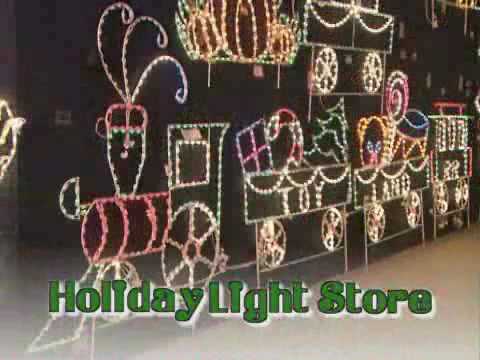
The math above gives you a safe ceiling. The right display makes that ceiling easy to work with. At The Holiday Light Store, our handmade outdoor light sculptures are powder-coated and built in the USA, so they hold up season after season instead of corroding after one winter.
Every piece is designed for real yards and real weather. If you are unsure how a display fits your circuits, our team can help you plan the load before you buy.
Frequently Asked Questions
How many holiday light displays can you plug into one outlet?
It depends on the wattage of each display and the circuit’s capacity, not the outlet itself. A standard 15-amp circuit supports about 1,440 watts continuous, while a 20-amp circuit supports about 1,920 watts. If each display draws 100 watts, that is roughly 14 displays on a 15-amp circuit. But the outlet’s wiring and the manufacturer’s limit on connected strands also matter. Always check the label on each display and stay under the 80% rule.
How do you calculate the wattage of multiple light displays?
Find the wattage on each display’s label or packaging, then add them together. If the label shows only amps, multiply amps by 120 volts to get watts. For example, a string labeled 0.5 amps uses 60 watts. Sum every device on the circuit, including any other appliances or tools sharing it, and compare that total to 80% of the circuit’s rating. A holiday lights wattage calculator or a simple spreadsheet makes this quick for large displays.
Do LED holiday lights use less power than incandescent lights?
Yes, significantly. A typical 100-count LED string uses about 5 to 10 watts, while a comparable incandescent string can draw 40 to 50 watts. That means you can connect many more LED strings to the same circuit before approaching the safe limit. LEDs also run cooler, which reduces the risk of overheating at plugs and connections. For large outdoor displays, switching to LED is the single easiest way to increase capacity without rewiring.
Is it safe to mix lights and outlets on the same circuit?
It is safe as long as the total load stays within the circuit’s safe limit. However, holiday lights are a continuous load, and the 80% rule applies. If the circuit already powers a garage freezer, a sump pump, or outdoor security lighting, those loads count toward the total. Adding a large light display to a circuit that is already heavily used can cause nuisance breaker trips or, worse, overload the wiring. Map every load on the circuit before you plug in.
The hardest part of a big display is not the wiring. It is finding pieces durable enough to justify the planning. The Holiday Light Store builds animated, powder-coated light sculptures made in the USA, with a range of holiday themes and construction meant to last for years. Get started with The Holiday Light Store and build a display your family will look forward to every season.

