
Sub-Total: $0.00
How to Power Extensive Holiday Displays Safely
| Blog
Last Updated: November 5, 2026
Quick Summary
To power extensive holiday displays safely, add up the wattage on each circuit, divide by 120 volts to get amps, and keep the total under 80 percent of the circuit rating, about 12 amps on a 15-amp circuit. Spread the load across several circuits, use outdoor-rated cords, protect connections with GFCI outlets and weatherproof covers, and use power injection for long pixel light runs.
- Divide total watts by 120 volts to find the amps on each circuit.
- Keep sustained load at or below 80 percent of the circuit rating, about 12 amps on a 15-amp circuit.
- Use outdoor-rated cords and avoid daisy-chaining extension cords.
- Test outdoor GFCI outlets monthly and replace any that fail to trip.
- Add power injection to long pixel light runs to prevent dimming at the far end.
Table of Contents
- Why Powering a Large Holiday Display Needs a Plan
- Calculating Your Holiday Display Power Requirements
- Choosing Outlets, Circuits and Outdoor Extension Cords
- Weatherproofing Outdoor Holiday Light Connections
- Power Injection, Controllers and Pixel Light Wiring
- What Powering Your Display Adds to Your Electricity Bill
- Booking a Licensed Electrician or Planning Your Next Display
- Frequently Asked Questions
Why Powering a Large Holiday Display Needs a Plan
Powering an extensive holiday display is less about the lights and more about the electricity behind them, so a power extensive holiday plan starts with the wiring. Most failed displays fail for the same reason: someone plugged too much into too few circuits. A small string of lights barely registers on a home’s electrical system, but a yard full of animated light sculptures can pull enough current to trip breakers and blow fuses within minutes.
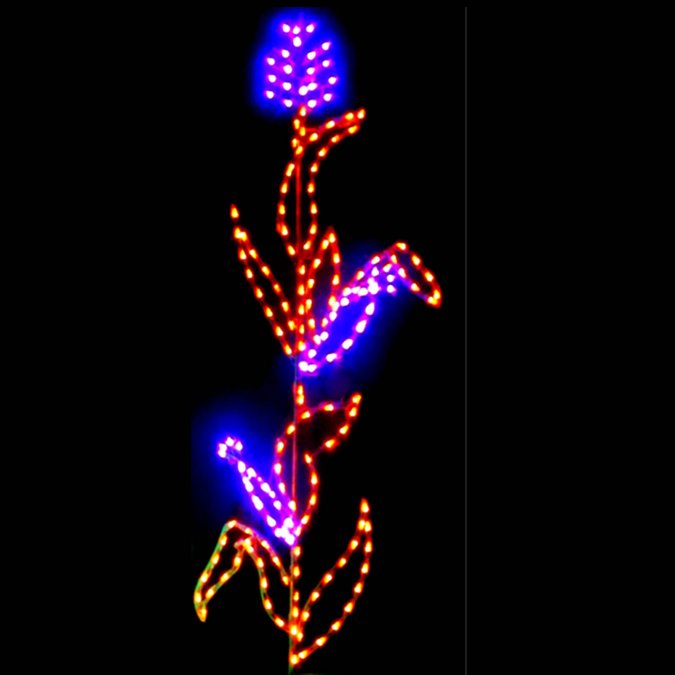
Holiday lighting is a real electrical load, and every power extensive holiday setup has to account for it. Nationally, holiday lights account for about 6.6 billion kilowatt-hours of electricity each year, according to ElectricChoice’s analysis of holiday lighting energy use. That figure reflects how many households and businesses rely on powered displays, and it shows why planning matters.
Good planning starts before you plug anything in. Map out where every display will sit, count the outlets you can actually reach, and note which circuits serve each one. Then add up the load.
Calculating Your Holiday Display Power Requirements
To know whether your setup is safe, you need one number: the total amperage each circuit will carry. The math is simple. Power in watts divided by voltage gives amps. In the United States, most household outlets run at 120 volts.
Follow these steps for each circuit:
- List every light set, controller, and power supply on that circuit.
- Find the wattage printed on each label or in the product manual.
- Add the wattages together.
- Divide the total by 120 to get amps.
- Compare the result to the circuit’s rating, usually 15 or 20 amps.
Stop at 80 percent of the circuit rating. This is the common guideline for continuous loads, since holiday displays often run for many hours at a time. A 15-amp circuit should stay at or below about 12 amps of sustained load.
Worked Example: Totaling the Load on a Single Circuit
Say you want to run three light sculptures, a string of LED rope light, and a controller on one 15-amp circuit. Here are the wattages:
| Item | Wattage |
|---|---|
| Sculpture A | 180 W |
| Sculpture B | 150 W |
| Sculpture C | 210 W |
| LED rope light (50 ft) | 60 W |
| Controller | 15 W |
| Total | 615 W |
Divide 615 watts by 120 volts and you get about 5.1 amps. That is well under the 12-amp safe limit, so this circuit works. If you added two more large sculptures at 200 watts each, the total would climb to about 1,015 watts, or roughly 8.5 amps. You would then need to split the load onto a second circuit.
Choosing Outlets, Circuits and Outdoor Extension Cords
Not every outlet is equal. Use outlets on different circuits when you can, so one overloaded circuit does not take down the whole display. Get the per-outlet rules for how many displays can share an outlet. Check your home’s breaker panel and label which outlets share a breaker.
For outdoor work, use cords rated for outdoor use. Look for the letters “W” in the cord jacket marking, which indicates weather resistance. Match the cord’s gauge to the length and load. Thin cords over long distances heat up, and that heat is a fire risk.
Keep these habits in mind:
- Avoid daisy-chaining extension cords. Connect them end to end only when the manufacturer allows it.
- Never run a cord under rugs, through doorways, or across walkways where it can be pinched or stepped on.
- Use a power strip or outlet with built-in surge protection for controllers.
- Do not plug a heavy display into a single outlet adapter.
Avoiding Voltage Drop on Long Cable Runs
Voltage drop happens when electricity travels a long distance through a cable and loses strength along the way. You see it as dim lights at the far end of a display or sculptures that flicker or behave oddly. The longer and thinner the cable, the worse the drop.
To limit it, shorten your cable runs where possible, use a heavier-gauge cord for long distances, and power a distant section from its own outlet rather than daisy-chaining it. If the far end of a run looks dim, that is usually your first clue to split the load.
Weatherproofing Outdoor Holiday Light Connections
Rain, snow, and morning dew are the enemies of every outdoor connection. Learn how to prevent outdoor light corrosion. A wet plug can short out, and moisture that gets into a connector will corrode the metal over time. Weatherproofing is not optional for outdoor displays, and the details matter more than the general advice.
Start with GFCI protection. A ground-fault circuit interrupter cuts power in a fraction of a second if it detects current leaking to ground, which is exactly what happens when water gets where it should not. Most outdoor outlets should already be GFCI-protected. Test them monthly using the built-in test button, and replace any GFCI that fails to trip.
Next, protect each connection point with the right hardware:
- Use weatherproof cord covers or outdoor-rated connector boxes at every plug junction. Look for enclosures marked with a NEMA rating; a NEMA 3R or NEMA 4 enclosure resists rain and splashing, while a basic indoor box does not.
- Choose connectors rated for outdoor use. Twist-lock and sealed inline connectors hold up better than bare plug-and-socket joints, and heat-shrink or self-sealing splice kits protect cut-and-reconnected pixel runs.
- Keep plugs off the ground by elevating them on a hook or stake, ideally 6 to 12 inches above grade.
- Point drip loops downward so water runs off rather than into the connector. Every junction should have a low point below the plug.
- Seal unused outlets with while-in-use covers, and store spare connectors in a dry, sealed container.
Cable routing is part of weatherproofing. Run cords along fences, railings, or the house wall rather than across the lawn, and use cable clips or stakes to keep them off wet ground. Where a cord must cross a walkway, use a cord cover ramp rated for foot traffic rather than taping the cord down.
Watch out: a connection that looks sealed can still collect water if the drip loop points the wrong way or the cover is cracked, so inspect every junction after the first hard rain and again after a freeze-thaw cycle.
Wind is the other threat. Strong gusts can pull over stakes and yank cords loose. See seven methods for securing holiday displays in wind. Secure cords along a fence or railing with UV-resistant ties, stake large sculptures firmly into the ground, and add guy lines to tall inflatables. Check tie points after storms, since UV degradation makes plastic ties brittle over a season.
Power Injection, Controllers and Pixel Light Wiring
Pixel lights, the kind that can show chasing patterns and moving effects, need more than a basic plug-in string. Each pixel draws a small amount of current, but a long run adds up, and the voltage at the far end sags. Power injection means feeding power into the line at intervals instead of relying on one supply at the start.
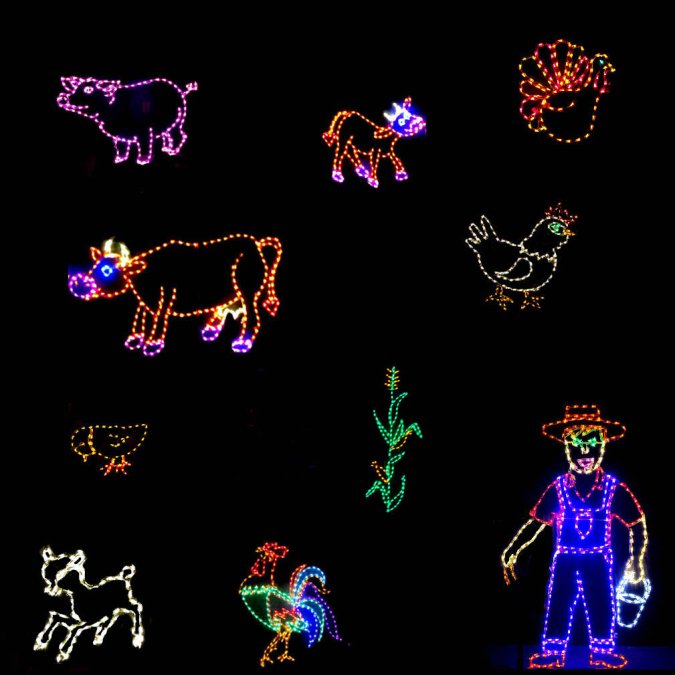
A typical setup includes a controller that sends data signals and one or more power supplies that deliver current. The controller and the power supply are separate concerns: the controller handles data, and the supply handles current.
Injection spacing depends on pixel type, wire gauge, and supply voltage. Work from the manufacturer’s maximum run length and injection spacing for the specific product, because a 5-volt pixel run and a 12-volt pixel run behave very differently.
A worked voltage-drop check helps. If a run of pixels is rated at a given current per pixel, multiply that by the number of pixels to get the run’s total current, then use the wire resistance for your gauge and length to estimate the drop.
Many customers ask about a common mistake with pixel lights: wiring data and power lines in the wrong order or connecting too many pixels to a single injection point. Data flows in one direction, so the controller’s data output must reach the first pixel’s data input, and the ground must be common between controller and supply.
Troubleshooting flicker and odd behavior starts with the power path. If the first pixels in a run look correct and the last ones flicker or dim, suspect voltage drop and add injection.
What Powering Your Display Adds to Your Electricity Bill
Holiday lights do cost money to run, and the bill can be bigger than many people expect. The cost depends on total wattage, how many hours per night the display runs, and your local electricity rate.
To estimate your cost, multiply total wattage by hours per day, divide by 1,000 to get kilowatt-hours, then multiply by your rate per kilowatt-hour. For example, a 600-watt display running 6 hours a night for 30 days uses about 108 kilowatt-hours. At an average rate of about 17 cents per kilowatt-hour, that comes to roughly $18 for the month. Check your own rate on your utility bill, since prices vary by region.
LED lights draw far less power than older incandescent sets, so switching to LEDs is one of the easiest ways to cut costs. Setting timers to shut off displays late at night saves more.
Booking a Licensed Electrician or Planning Your Next Display
Some jobs belong in the hands of a licensed electrician. Call one if your breaker panel is old, if you need a new dedicated outdoor circuit, or if a circuit trips even at low loads. Electricians can also check whether your home’s wiring can handle a large display. Local rules vary, so ask your building department whether a permit is needed before you start.
If you are planning a bigger display for next season, start early. Map your circuits now, decide which sections need their own outlets, and order any extra cords or power supplies before the rush. Use the load math above to plan each section.
Frequently Asked Questions
How do you power multiple outdoor Christmas lights?
Start by adding up the total wattage of every display and light string, then divide by the circuit’s rated amperage at 120 volts to see how many can run safely on one circuit. Spread the load across several outdoor GFCI-protected outlets or separate circuits rather than daisy-chaining strings into one plug. Keep the total under about 80 percent of the circuit’s rating, which is the standard guidance for continuous loads. Using a heavy-gauge outdoor extension cord rated for the total amperage also prevents overheating at connections.
How much do Christmas lights add to your electric bill?
The exact cost depends on how many watts your display draws, how many hours it runs each night and your local electricity rate. To estimate your own cost, multiply the total wattage by the hours of operation, divide by 1,000 to get kilowatt-hours, then multiply by your utility rate per kilowatt-hour. LED lighting and timers reduce that figure considerably.
When should you use a separate circuit for holiday lights?
A dedicated circuit is worth considering when your display’s combined load approaches the rating of an existing circuit, or when lights repeatedly trip breakers. Shared circuits that also power a space heater, refrigerator or microwave are common causes of tripped breakers during the holidays. A licensed electrician can confirm circuit capacity and install an outdoor outlet on a dedicated line where needed, which is especially useful for large displays.
How can you prevent voltage drop across long runs of holiday lights?
Voltage drop becomes visible as dimming or flickering toward the end of a long string or cable run. Reduce it by using a heavier gauge cord, shortening the run, and injecting power at intervals for pixel lights. Limiting the number of lights on each run and powering long sections from a second outlet also keeps brightness consistent across the display.

